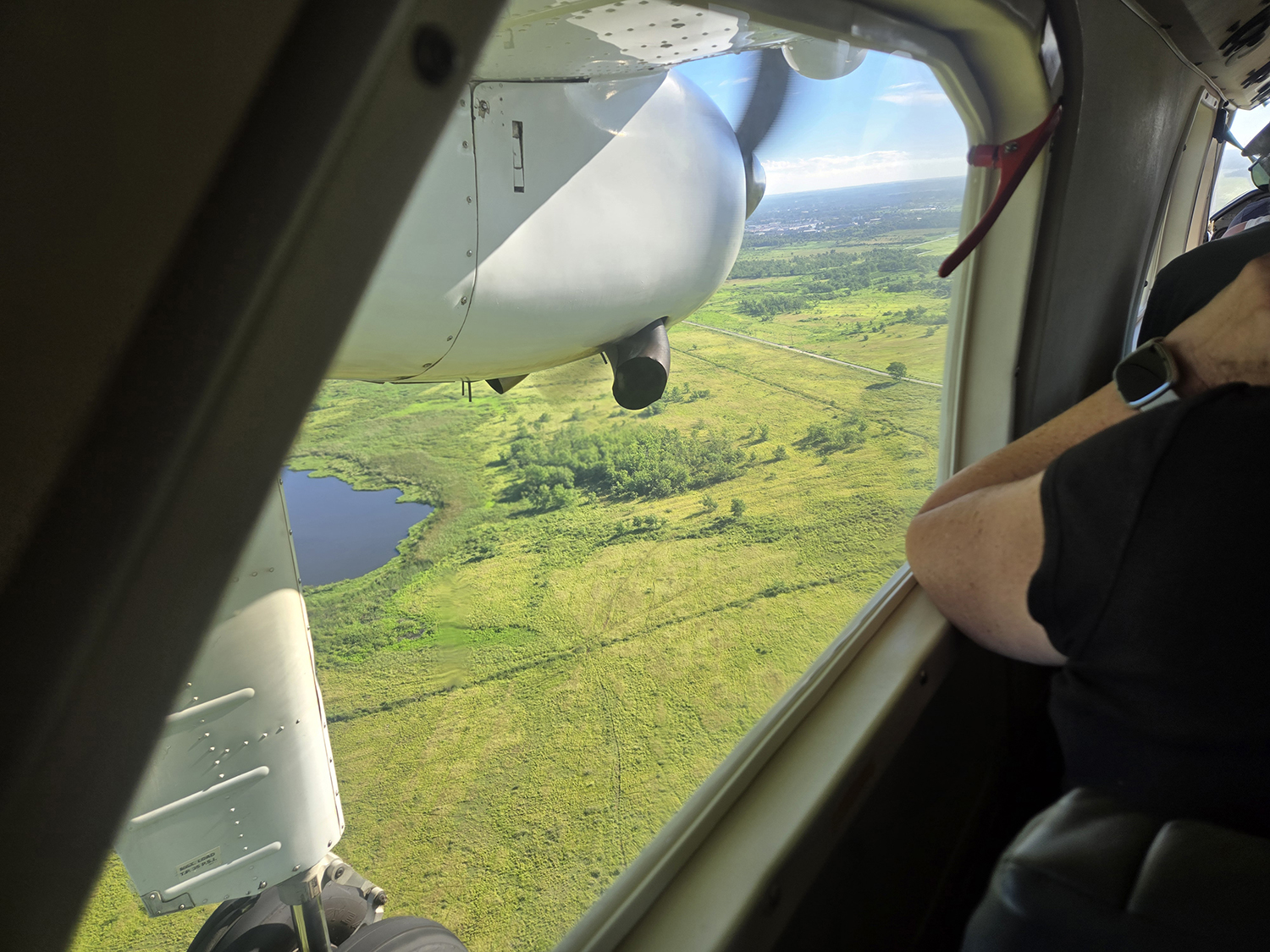

Last September (2025) I had the opportunity to fly from Key West to Havana, Cuba, with a small group of other Hemingway fans to take a tour of Hemingway’s Cuban home, Finca Vigia. We boarded a small 9 seater twin prop and flew 90 miles due south in blue skies and under a hot sun.


The Finca Vigia, which means “Lookout Farm,” is about 10 to 12 miles southeast of Havana in what was at the time the small village of San Francisco de Paula. A Catalan architect named Miguel Pascat Baguer built it in 1886. Hemingway bought it in 1940 for $12,500, (about $300,000 in today’s dollars), and he and his third wife, Martha Gelhorn moved in. That marriage lasted only a few years, and it was his fourth wife, Mary Welsh, who spent most of the twenty years he lived there.
Our group rode in a pleasant, air conditioned shuttle van from the airport directly to the Finca Vigia.Our guide and driver were outstanding. Our guide, who spoke 5 languages, kept up a steady stream of Hemingway history.
We arrived a few minutes before the gates to the grounds were opened. The driver parked outside and kept the van idling to keep the air conditioning going. This gave us a chance to see a small slice of San Francisco de Paula life. The poverty around us was depressing, and the high fences and barbed wire indicated a rough life for the residents.
I did not take photographs, as I felt that would have been disrepectful, but there is a Cuban native, Evelyn Sosa, who has done photo essays of the area. You can see some of that work here. Sosa’s work has been exhited many times, and for those who wish to get a better visual sense of Havana and Cuba than I could ever convey, you can browse more of her work here.
When the gates opened, we were the first to enter and walk around the grounds. That was nice having it alone for a few minutes, but the place quickly filled with tourists from around the world.

The grounds are beautiful, and cover about 15 acres. No one is allowed to actually go inside the house, and at first I was disappointed about that. But you can look in all the open doors and windows, and really, that works well. And after visiting, I can see why the rule is in place. The house is exactly as it was when Hemingway left it on July 25, 1960. He always intended to return, so everything: clothes, books, liquor bottles, everything, is still as it was the day he walked out. Imagine thousands of tourists walking through the home touching and possibly nicking a few souvenirs. The house would not survive.


Our time at the Finca Vigia was not long enough, I felt. I could have stayed for hours. The volunteers were so wonderful. I tipped $5.00 to each volunteer who helped with the photo taking, and I left a general $20.00 tip to who I believe was running the show. But our little group still had a tour of Havana to do, and so we piled into the shuttle van and began the drive into Havana. That turned out to be great trip also, but I will have to save that for Part 2.
– David Grant Urban
___________________________
____________________________
A follow up note: I recently saw this YouTube Video of an interview with Ernest Hemingway, taken after winning the 1954 Nobel Prize for literature. Hemingway was suffering greatly from 2 airplane crashes in Africa; his manner and speech show his recovery was still ongoing.
I wondered if any of my photos of the Finca Vigia showed the room he was being interviewed in, and I found a couple:


