I grew up in San Diego, CA. In the 1980’s, I met the mayor of Imperial Beach, Brian Bilbray who at the time was battling an unbelievable ecological disaster to no avail. He did me a favor once I will never forget, but I’ll touch on that another time. But the ecological disaster continues under the radar, and no one seems to care. So here are some facts you may find interesting:
The Disaster That Never Ends
Since the 1980s, on the order of 200 billion gallons of sewage-bearing wastewater have crossed from Tijuana into California — including more than 100 billion gallons in the official tally since 2018 alone. Compared with the environmental catastrophes that seized national attention in the last few years, the numbers are almost absurd — and the silence around them is the real story.
A essay on volume, attention, and a 90-year public-health failure
Most environmental disasters announce themselves. A black column of smoke. A town on fire. A plume you can see from the interstate. The Tijuana River does none of that. It just keeps arriving — foam, hydrogen sulfide, trash, industrial chemicals, and raw sewage — through a concrete channel, across an international line, into an estuary, and out to the Pacific at Imperial Beach.
Start with the figure that has an official stamp. The International Boundary and Water Commission says more than 100 billion gallons of raw sewage laced with industrial waste and trash have crossed into the United States through the Tijuana River since 2018. Peak years were brutal. Total transboundary flow hit about 44 billion gallons in 2023 and about 36 billion in 2024. Heal the Bay’s 2025–2026 beach report put the latest reporting year at roughly 20 billion gallons, averaging 55 million gallons a day. Even in drier recent stretches, dry-weather sewage still moves north.
That post-2018 number is not the beginning of the story. It is the part that finally got a consistent meter. The river had already been running raw for a generation.
From the 1980s to the official tally
In January 1980, storms and a dam release broke the 30-inch pipe that had been carrying most of Tijuana’s sewage toward Point Loma. More than 15 million gallons a day of Mexican sewage then streamed through the estuary and out to sea. San Diego County quarantined four miles of beach, from the border to the naval amphibious base. Rainy winters in 1981–1983 repeated the spills.
The pattern settled in. David Gibson, longtime executive officer of California’s San Diego Regional Water Quality Control Board, later described the 1980s and early 1990s this way: the Tijuana River was “nothing but sewage, and it was untreated sewage at about 14 to 18 million gallons a day, rain or shine. It was chunky, raw sewage, you could see the paper, the debris in it.” Other contemporary counts sit in the same range: 10 million gallons a day into the river valley in one mid-1980s summary; 4.5 to 7 million gallons of “renegade” canyon flow on a normal 1988 day, plus extra when a main broke; up to 20 million gallons a day discharged back into the valley after Tijuana’s new system failed in 1990.
Take Gibson’s midpoint — 16 million gallons a day — and run it from 1980 through 1996, the last full year before the South Bay International Wastewater Treatment Plant came online. That is about 99 billion gallons of untreated sewage in the river alone. Call it 100 billion for the pre-plant era, with the understanding that some days ran lower and storm weeks ran much higher.
The 1997 plant, built to treat 25 million gallons a day, and Mexico’s San Antonio de los Buenos plant (about 17 million gallons a day when it worked) cut dry-weather river flows for a time. They did not end the problem. Canyon collectors still overflowed. Pipes still ruptured. SAB spent long stretches bypassing untreated sewage to the surf at Punta Bandera, where northbound currents carried it onto Imperial Beach. Wet-season river volumes after 2000 still averaged on the order of 9 billion gallons a season. Then, after 2016–2017, dry-weather transboundary flows snapped back from occasional to chronic, and the official post-2018 clock started.
Add the documented 1980–1996 river years to the IBWC’s 100-billion-gallon count since 2018, and the sewage-bearing volume since the 1980s sits on the order of 200 billion gallons. The middle decades, 1997–2017, add more — spills, canyon crossings, SAB ocean discharges — but those years were never tallied the way the last eight have been. A precise grand total does not exist. A responsible floor does: at least 200 billion gallons of sewage-laced water into California since 1980, and that is before counting every storm pulse in the 2000s.

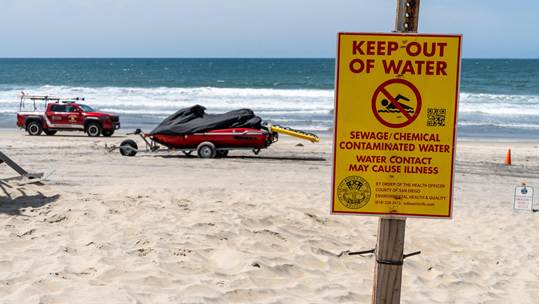
Imperial Beach: county health signs still keep people out of the water. Photo: Times of San Diego.
Imperial Beach has lived with the result. Stretches of shoreline have been closed for more than a thousand consecutive days. County health signs still tell people to stay out of the water. A 2024 household survey near the river found that 71 percent of nearby homes could smell sewage indoors and 69 percent had a household member who got sick from exposure. Navy SEAL candidates training in the same water logged more than a thousand gastrointestinal illnesses between 2019 and 2023. Scientists have measured hydrogen sulfide in the valley air at levels thousands of times typical urban concentrations.
This is not new. Complaints date to the 1930s. What changed after 2016–2017 was the shift from episodic spills to a near-permanent condition: failing collectors in Tijuana, a Mexican coastal plant that sat dead for years, an aging U.S. plant running over design capacity, and then the atmospheric rivers of 2023–2024.
Recent work has finally moved the needle. The South Bay International Wastewater Treatment Plant was expanded from 25 to 35 million gallons a day in a 100-day sprint. Mexico brought the San Antonio de los Buenos plant back online in 2025 at 18 million gallons a day. A 2025 U.S.–Mexico memorandum and Treaty Minute 333 set 2027 targets for a 50-million-gallon U.S. plant, a rebuilt Pump Station 1, and a rehabilitated gravity line. Flows have dropped in some dry-weather windows. Pipes still rupture. Beaches still close.
That is the baseline. Now put it next to the disasters that actually owned the news cycle.
East Palestine, Ohio — February 2023
A Norfolk Southern train derailed. Vinyl chloride and other chemicals burned in a controlled fire that produced the kind of photograph editors cannot resist: a mushroom of black smoke over a town of 4,700. About 3,500 fish died in nearby creeks. Cleanup crews later hauled away more than 176,000 tons of contaminated soil and more than 44 million gallons of tainted water. Air and drinking-water tests after the evacuation was lifted generally stayed below action levels, though residents still report symptoms and researchers continue to argue about long-term risk. The plume, one study found, deposited unusual chemical signatures across 16 states.
Forty-four million gallons of contaminated water removed from one site is a serious event. It is also roughly what the Tijuana River can send north in a single high-flow day, and it is a rounding error against 100 billion gallons since 2018 — let alone the 200-billion-gallon floor since 1980. East Palestine was acute, photogenic, and over — in the official sense — within months. Imperial Beach has been living inside its version of the event for years.

East Palestine, Ohio, February 2023: the image that defined a national story. Photo: AP / STAT.
Red Hill, Hawaiʻi — November 2021 (and 80 years of leaks)
The Navy’s underground fuel farm above an Oʻahu aquifer released about 19,000 gallons of jet fuel into a drinking-water system that served roughly 93,000 people. Thousands reported headaches, rashes, nausea. Wells were shut. The facility is being closed. Historical leaks at the site, depending on the estimate, run from about 180,000 gallons documented over 80 years to a state working-group range that climbs toward 2 million gallons.
Two million gallons is a contamination crisis for an island aquifer. It is about 1/50,000th of the official Tijuana volume since 2018, and a still smaller slice of the record since 1980. Red Hill poisoned drinking water in a single, traceable pulse. The Tijuana River poisons beaches, air, and an estuary every day, on both sides of the line, with no single responsible operator and no single date when it “happened.”
Lahaina, Maui — August 2023
The deadliest U.S. wildfire in a century killed more than 100 people and erased a historic town. EPA crews later pulled more than 200 tons of hazardous debris from burned lots. Ash and burned building materials raised legitimate fears about runoff into nearshore reefs. That is a catastrophe in the full sense of the word: sudden death, cultural erasure, toxic aftermath.
It is a different species of disaster. Fire is an event. Sewage in the Tijuana River is a system. One produces funerals and a national mourning period. The other produces yellow signs and another year of “keep out of the water.”
The other border river
California has a twin problem few people outside the Imperial Valley can name. The New River crosses at Calexico carrying Mexicali sewage, farm runoff, and industrial waste toward the Salton Sea. It has been called one of the most polluted rivers of its size in the country. Pathogen counts at the border have been measured in the tens and hundreds of thousands of colonies. Governor Newsom’s 2026 funding announcement bundled the New River with the Tijuana River for a reason. Both are chronic, binational, and structurally boring to a national audience.
Why scale does not equal attention
Three things separate the Tijuana crisis from the disasters that break through.
First, it is chronic. News organizations are built for the explosion, not the drip. A 90-year problem with no single villain and no single body count does not fit a two-minute package.
Second, it is binational. Responsibility is split among CESPT in Tijuana, CILA, the U.S. section of the IBWC, EPA, the State Department, San Diego County, Imperial Beach, and a thicket of treaty minutes. That is a recipe for delay, not for a congressional hearing with a smoking tank car behind the witness.
Third, the people who live with it are not a novelty. South Bay communities are heavily Latino and working-class. Surfers and Navy trainees get occasional ink. The families who smell hydrogen sulfide in the house at night do not.
Volume makes the comparison almost unfair. One hundred billion gallons since 2018 is enough to fill something like 150,000 Olympic swimming pools. Two hundred billion gallons since 1980 is closer to 300,000. The 2023 East Palestine water removal would fill about 67 of those pools. The 2021 Red Hill drinking-water event would fill a fraction of one. The Tijuana River has been running a slow-motion Superfund on a schedule.
None of that means East Palestine or Red Hill or Lahaina were overblown. Acute chemical fires and burned towns deserve the coverage they got. It means the country has a category error. We treat environmental harm as a spectacle. The Tijuana River is a utility failure that became an ecosystem, then a public-health condition, then background noise.
What “fixed” would actually look like
The 2027 target is not a slogan if the plants and pipes actually get built and then maintained. Tijuana generates something like 75 to 85 million gallons of sewage a day. Combined treatment capacity on both sides still does not cover that load plus storm peaks that can hit hundreds of millions of gallons in a day. Capacity without maintenance is how the last round of “solutions” decayed after the 1990s plant came online.
Until the dry-weather river flow is a trickle of stormwater instead of a sewage main, Imperial Beach will keep posting the same yellow signs.
The last few years gave the United States a set of environmental disasters it could photograph. This one it can only measure — in billions of gallons, in days of closed beach, in the number of people who learned not to open the window when the wind is wrong. That is the catastrophe. It just never looked like one on television.
Sources
Post-2018 volume: International Boundary and Water Commission / EPA figure of more than 100 billion gallons. 1980s–1990s river flows: contemporaneous reports of 15 million gallons a day after the 1980 pipe break; David Gibson, San Diego Regional Water Quality Control Board, on 14–18 million gallons a day “rain or shine” in the 1980s and early 1990s (San Diego Union-Tribune, 2018); 1988 Los Angeles Times canyon-flow counts; 1990 system-failure discharges of up to 20 million gallons a day. Pre-plant era estimate uses Gibson’s midpoint (16 MGD) × 17 years (1980–1996) ≈ 99 billion gallons. Other sources: Heal the Bay Beach Report 2025–2026; EPA USMCA baseline documents; Coronado News crisis timeline; EPA and GAO materials on East Palestine and Red Hill. “Sewage-bearing wastewater” includes untreated sewage and mixed river flows; stormwater shares of later wet-season totals cannot be fully separated.
Share this: